AMLR: how AI turns regulation into traceable action
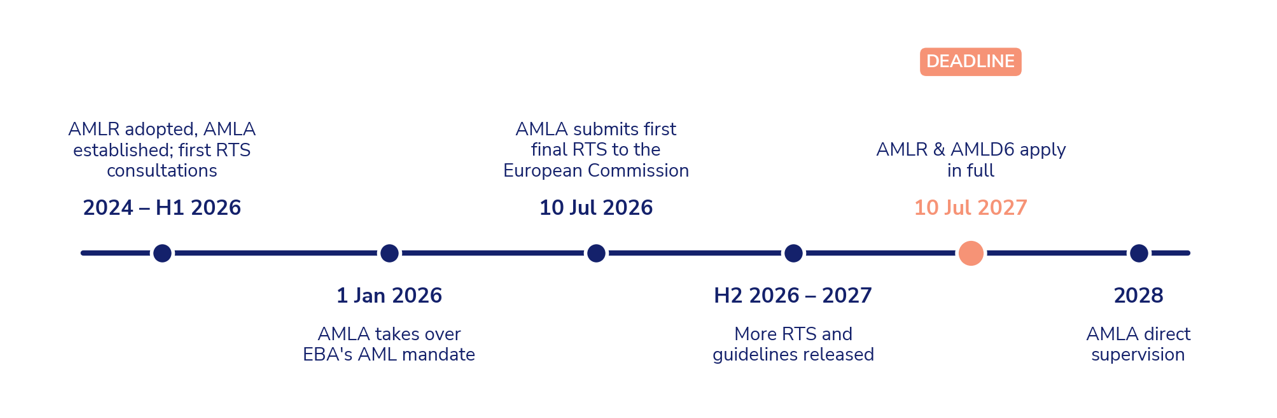
From 10 July 2027, the Anti-Money Laundering Regulation (AMLR, Regulation (EU) 2024/1624) applies directly in every EU member state and largely replaces the Dutch Wwft.
From 10 July 2027, the Anti-Money Laundering Regulation (AMLR, Regulation (EU) 2024/1624) applies directly in every EU member state and largely replaces the Dutch Wwft. Most attention goes to what changes on paper: new thresholds, a harmonised CDD dataset, a broader PEP definition.
The bigger shift is less visible. Under the AMLR, supervisors will ask you to show why you made each decision: why a transaction was reported or not, why a level of due diligence was proportionate, and who signed it off. Having a process is no longer enough. Your reasoning must be documented, reproducible and traceable back to the regulation.
In this blog we look at what changes, why explainability becomes the real bottleneck, and how AI can turn AMLR requirements into traceable action faster, without losing the line back to the source.
From 27 rulebooks to one
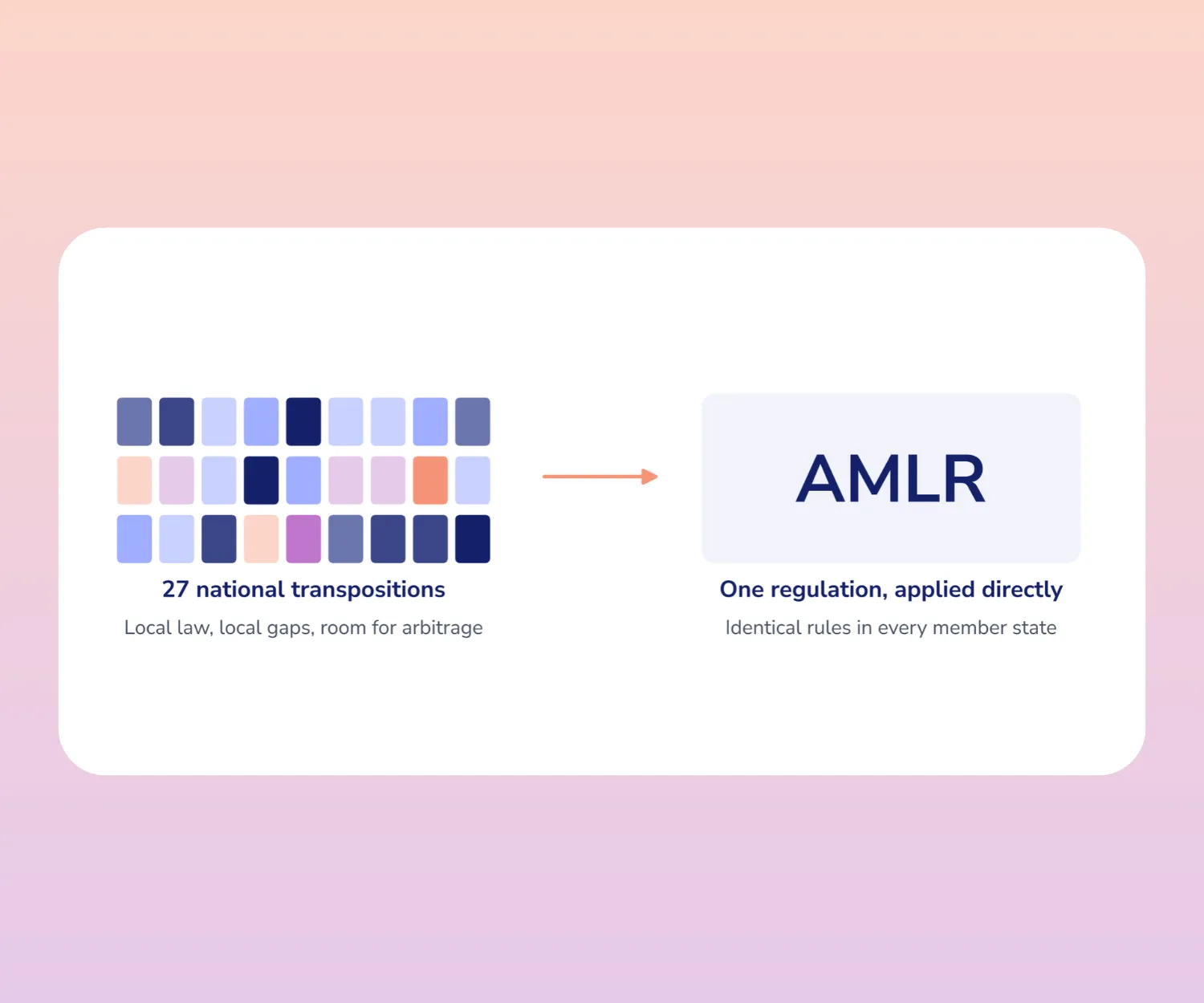
Until now, EU AML rules came through directives that each member state transposed into its own law; in the Netherlands, the Wwft. That created local gaps, inconsistent interpretation and room for regulatory arbitrage. The AMLR applies directly, without national transposition: the same rules for a bank in Paris as for one in Amsterdam.
What actually changes: from the Wwft to the AMLR
The AMLR touches almost every part of the AML/CTF framework. These are the main shifts for Dutch institutions:
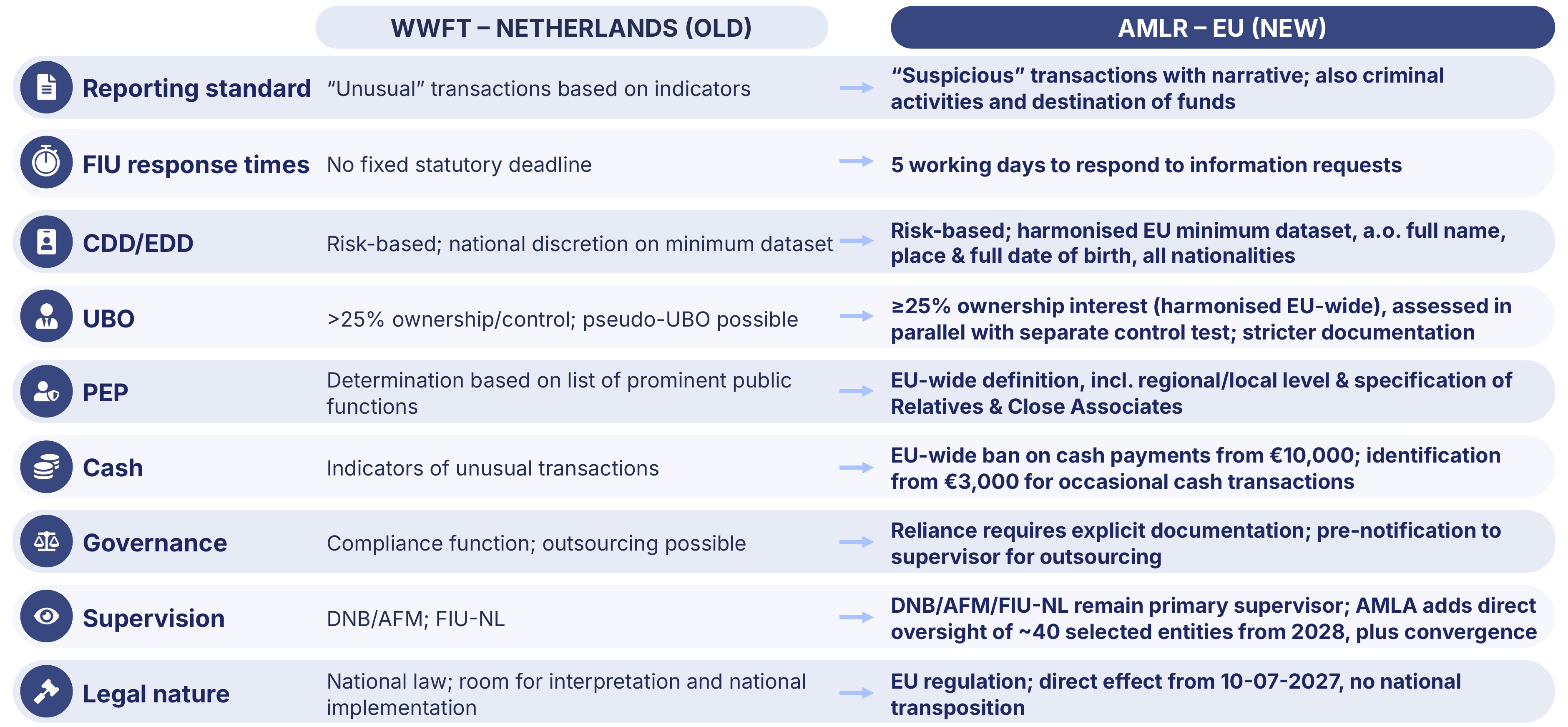
Every change is a decision you will need to evidence
A SAR now needs a narrative. EDD needs a documented proportionality rationale and management approval. A UBO needs a separate control test, and reliance needs a file. The question supervisors will ask is no longer “do you have a process?” but “show me how you reached this decision”.
Supervision is changing too. The Anti-Money Laundering Authority (AMLA) in Frankfurt will directly supervise around 40 high-risk cross-border institutions from 2028. For all others, DNB and AFM remain the supervisor, while AMLA sets binding standards and drives convergence across member states.
The real challenge is translating the AMLR into auditable, traceable action
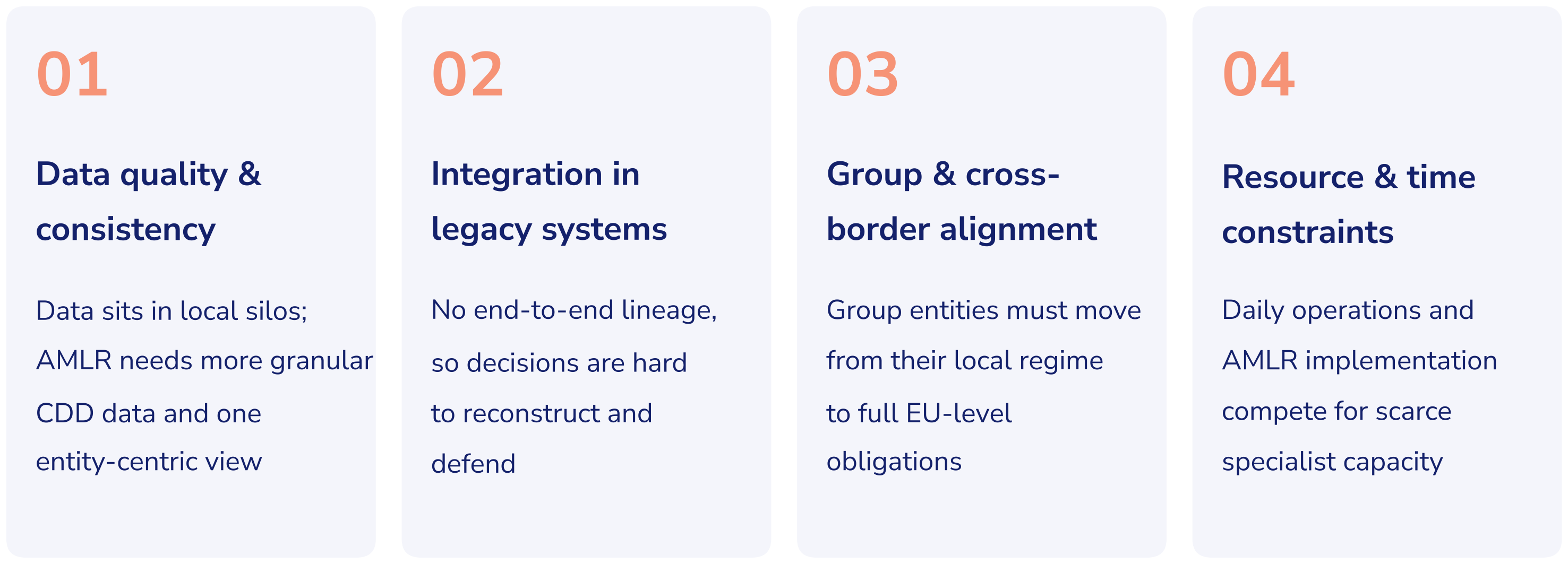
Understanding the AMLR is not the hard part. In our work with financial institutions, four bottlenecks keep coming up:
Data quality and consistency: the AMLR requires data that most institutions don't yet capture in a consistent, traceable way.
Integration in legacy systems: the requirements go beyond what legacy systems were built to handle.
Group and cross-border alignment: implementation must be consistent across group entities and jurisdictions.
Resource and time constraints: teams must run daily operations and a major change programme at the same time.
How can we accelerate AMLR implementation with a clear lineage?
This is where AI adds value, provided every output stays traceable to the source article. AMLA itself has signalled its support for innovative technology that strengthens AML/CTF effectiveness. We see six concrete use cases:
Horizon scanning: tracking new RTS and guidelines as AMLA publishes them.
Regulatory requirements and scoping: identifying which AMLR obligations apply to your institution.
Policy gap assessment: comparing your policies against every applicable obligation.
Procedures gap assessment: checking whether procedures actually implement those policies.
Group to subsidiary comparison: aligning local entities with group-wide requirements.
Control assessment: testing whether controls cover the obligations, with the line back to the regulation intact.
With RegAI Helia, our AI platform, Ace supports each of these steps. Every requirement stays traceable from the regulatory text to the risk, the control and the underlying data, so you can show supervisors exactly how each decision was reached.
Start with the evidence trail
July 2027 is closer than it looks, and the first RTS are already with the European Commission. Institutions that build traceability in from the start will not just comply; they will be able to explain every decision they make, to their board and to their supervisor.
Curious how traceable your AMLR implementation is today? Request a RegAI Helia demo, in which we take an AMLR obligation from the regulatory text through to your policy, procedure and control. Want to know more? Get in touch.
Geschreven door

“Wees de verandering die u in deze wereld wilt zien”